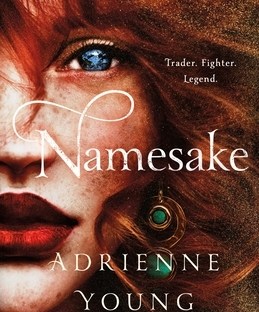



Trader. Fighter. Survivor.
With the Marigold ship free of her father, Fable and its crew were set to start over. That freedom is short-lived when she becomes a pawn in a notorious thug’s scheme. In order to get to her intended destination she must help him to secure a partnership with Holland, a powerful gem trader who is more than she seems.
As Fable descends deeper into a world of betrayal and deception, she learns that the secrets her mother took to her grave are now putting the people Fable cares about in danger. If Fable is going to save them then she must risk everything, including the boy she loves and the home she has finally found.

No, your eyes do not deceive you, I did actually read a sequel of a book and have enough thoughts for a review right after reading the first in the series! Very out of character for me. See my review of book one, Fable, here.
This review will inevitably contain spoilers for the first book, so here is your official warning. Go read that one first!
We start out the sequel on board the Luna, with Fable captured by Saint’s rival Zola, the main antagonist of the previous book. Fable has to quickly get her bearings, and safety among a crew that want her dead (for the murder of one of their shipmates, by the hand of West). A face from her past also pops up which brings some early intrigue.
There’s a quick trip to Jeval to pick up dredgers, and Fable’s old nemesis Koy comes aboard, adding more movement to an already dynamic plot. Throughout the book, this kind of antagonistic complexity continues, with Fable constantly questioning motives, making limited choices on who to trust, and how to maintain the unbreakable rule of the Narrows: never owe anyone anything.
Now I was the girl who’d found her own way. And I also had something to lose.
The plot does get a little tangled up near the tail end of the book, with the introduction of another figure from Fable’s past (or rather her mother’s) and the convalescence of multiple lines of scheming.
The eclipsing of one antagonist for another (think big fish eats little fish vibes) worked really well in this. The transition is used as a way to widen the worldbuilding from the first book, introduce some emotional growth for Fable, and ultimately opens the door for the third book without making Namesake feel like a bridge book.
I continued to love Fable’s character, as she starts to come into her own as a leader and gem sage. There’s a deeper exploration of family and what it means to the countries of Narrows and Bastian, and Fable is pressed to view her family both as people she loves, and is supposed to love, as well as flawed people driven by their own aims. Saint was a particularly perplexing character and I’m looking forward to seeing how things go there in the next book (yes, I’m reading the next one!).
There are some things that can’t be carved from a person, no matter how far from home they’ve sailed.
All this leads me to the most interesting conversation involving this book: West. He was set up as the love interest at the end of book one and his evolution, and Fable’s reaction to both him and Saint (I’ll get there momentarily!) was really interesting through a feminist lens.
In my view, there are two ways to write: the way things are, and the way they should be.
In the vast, vast, vast majority of books I’ve consumed, the author takes the former approach and even with the addition (in the last 20 years or so) of “strong female characters,” there are undercurrents of patriarchal thinking embedded everywhere.
Case and point: in Namesake, Fable makes a deal with the new Big Bad to find a gem and tells West specifically not to get involved for the good of himself, the crew, and her own peace of mind.
Predictable, West does the typical “I’m not leaving this place without you” which has been traditionally portrayed as oh so romantic. (it’s not, sorry not sorry) He breaks the trust of his crew by going full authoritarian and goes with Fable to complete the mission. The entirety of the journey and excavation is punctuated by anger and distrust from the crew (who Fable found a family with in the first book!), terrible clinginess from West, and overall an abundance of pressure on an already emotionally-charged mission.
Because you and I have cursed ourselves, Fable. We will always have something to lose. I knew it that day in Tempest Snare when I kissed you. I knew it in Dern when I told you that I loved you.
We’ve seen it all before. (as you notice all the “I’s” instead of “we’s” in the above quote)
What’s interesting here, and where I think the author is attempting to reach for that second method, is Fable’s response to West’s controlling behavior. Typically, female protagonists will put up weak protestations but ultimately conclude their male companions just “love them so much, it’s such an epic love.”
But Fable pushes back.
Vocally to West, to the crew, in her thoughts, all of it. And even when she seems to accept that this is just who West is, there’s a distinct echo of “he isn’t who I thought he was.”
There’s some wavering with Willa, a member of the crew and West’s sister, when she accuses Fable of fault for the whole situation they find themselves in. At first, Fable is very clear while also remaining sympathetic, that West is the one that chose what happened, and she is not responsible for his choices or actions.
However, she gets a bit shaky on that point near the end of the book when reuniting with Saint and remembering that she had always been told her mother, Isolde, was “his ruin.” Notice below the second sentence? Buddy, I hate to break it to you but if you didn’t want to be a father, there’s a very simple way to prevent that.
I didn’t plan to be a father. I didn’t want to be one. But the first time I held you in my hands, you were so small. I had never been so terrified of anything in my life. I feel like I’ve barely slept since the night you were born.
So all in all, I was really excited about the narrative the author was building in the first 2/3, but it slipped back a bit near the end. I’m hopeful for the next book, however, based on Fable’s visible thoughts during some of these conversations.


 Blue Eye Books